
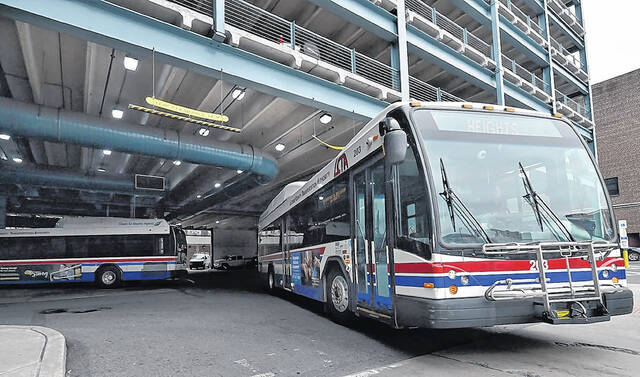
WILKES-BARRE — Gov. Josh Shapiro’s spokesman, Manuel Bonder, said the governor knows how critical mass transit is to the Commonwealth — and he has been fighting to deliver funding and solutions his entire time in office.
“From flexing funding to SEPTA when the system needed it most, to securing critical stopgap funding in last year’s budget, to continuing to work towards a final budget that delivers for mass transit all across Pennsylvania this year,” Bonder said of the Governor’s efforts. “The House has taken bipartisan action and passed this funding four times this year, and the Senate has the votes to get it to the Governor’s desk. It’s time to get this done.”
State Rep. Jim Haddock, D-Pittston Township, agrees with the Governor, and he looked at the local impact Mass Transit bill HB 1364 would have on the region and across the state.
Haddock said the bill was voted out of the House and is now sitting in the Senate for a vote. Luzerne County legislators Rep. Eddie Day Pashinski, D-Wilkes-Barre; Rep. Dane Watro, R-Hazleton, and Haddock, voted for the bill. Rep. Alec Ryncavage, R-Hanover Township; Rep. Jamie Walsh, R-Ross Township; and Rep. Brenda Pugh, R-Dallas Township, voted against it.
Rep. Haddock provided the local impact of funding on NEPA:
• County of Lackawanna Transit System (COLTS): $11.5 million in the current budget, plus $2 million of new funding in the Governor’s proposed budget.
• Hazleton Public Transit (HPT): $3.4 million in current budget; $600,000 more in proposed budget.
• Luzerne County Transportation Authority (LCTA): $10.7 million in current budget; additional $2 million in proposed budget.
Rep. Haddock said no new taxes are proposed, citing some changes to the existing sales tax formula.
Rep. Haddock also provided some other numbers for the three main NEPA transportation organizations:
• In Luzerne County, the two transit authorities — LCTA and HPT — combine for 232 employees (full and part-time), over 983,000 fixed-route rides, and more than 119,000 shared ride ridership.
• COLTS has 230 employees, over 760,541 fixed-route rides, and more than 126,000 Shared Ride Ridership.
Rep. Haddock also said HB 1364 also contains funding for PennDot of $500,000 earmarked for bridges.
“There are nearly 1,000 bridges in our area — 420 of them are fair condition, and 215 of those are in poor condition,” Haddock said. “Those 215 poor condition bridges carry more than 1.3 million vehicles a day. The average bridge in our area was built in 1973 — and the average bridge in poor condition was built in 1952. Back in 1952 a tractor-trailer usually weighed about 15 tons. Today a loaded tractor-trailer can weigh up to 40 tons. Our bridges weren’t meant for the traffic volume or the weight. We need to fix them and I voted to fix them without raising taxes.”
Haddock said inflation and tariffs more than doubled the cost of fixing roads and bridges in the past few years.
“If we don’t act now, we’re going to see weight restrictions, lane closures, and God forbid, a bridge collapse,” he said. “I strongly supported increased funding for the state’s mass transit.”
Haddock said HR 1364 brought to the counties of Luzerne and Lackawanna a total of 25.6 million dollars back to the LCTA, HPT and Colts.
“People rely on our local transportation systems to get to work, the grocery store, school and medical appoints,” Haddock said. “Our local mass transit system is not only buses, but includes the share ride program. Many people use this invaluable program for medical appointments. I spoke with a veteran recently who said he lives alone. He has cancer and uses the share ride program to get to the VA for his medical appointments.”
Pashinski said the legislation represents a critical investment in our state’s infrastructure and public transit systems — something he said is long overdue.
“By dedicating a consistent portion of sales tax revenue to both public transportation and road and bridge improvements, this act ensures stable, predictable funding for the systems we rely on every day,” Pashinski said. “It’s also encouraging to see the creation of the Transportation Funding Advisory Commission, which brings together voices from across the state to plan for long-term, sustainable solutions. Infrastructure isn’t just about roads — it’s about economic growth, safety, job creation, and equity. With increased funding flexibility for local transit agencies and a thoughtful, strategic approach to bond issuance, this legislation balances immediate needs with long-term planning.
“Pennsylvania’s future depends on smart infrastructure policy, and this is a step in the right direction.”
The other side
Rep. Ryncavage offered a different view.
”I have to start with a very glaring reminder that Gov. Shapiro, yet again, called for an egregious amount of spending for the budget,” Ryncavage said. “A budget that House Democrats passed two weeks ago that was grossly unbalanced and with a price tag of $50.6 billion. This far exceeds the growth of state revenue at a time when Pennsylvania already faces a multi-billion-dollar structural deficit.”
Ryncavage said without the Senate “acting as our backstop, as it has been doing,” this budget would be spending at least $5.3 billion more than revenues, which could look like a tax hike of more than $2,000 per family in 2026.
“Everyday citizens do not get to spend more than what is in their bank account, and this should be the same for government,” Ryncavage said. “One point that remains a sticking point for my colleagues and I has been funding for mass transit, specifically SEPTA, the Philadelphia transit system.”
Ryncavage added, “I agree, public transportation plays an integral role across the Commonwealth for citizens to get to work, school, doctor appointments and more. But ridership on mass transit is still below pre-pandemic levels, while crime and ‘fare evaders’ (people who refuse to pay the fare) continues to increase.”
Ryncavage said in his role as a legislator, he must consider “the facts.” He listed those:
• Right now, 8.6% of all Sales and Use Tax receipts are earmarked for mass transit. That is $1.39 billion for the current fiscal year.
• In 2013-14 this was around $735 million.
• In 2024-25 it was nearly $1.2 billion (a 54% increase in funding from 2013-14).
“The truth is, funding for mass transit has already dramatically increased in the last decade, and taxpayers should know where their tax dollars are going,” Ryncavage said. “Before we increase funding, we need to understand how these funds are being utilized and whether it is both efficient and responsible.”
Ryncavage added, “All of Pennsylvania’s taxpayers deserve a safe, efficient, and accountable transit authority. Under the current framework, the majority of funding flows through the troubled Philadelphia transit system, which continues to strangle the rest of our transit systems across this Commonwealth. I believe there is no better time than now, as the Governor calls for an unbalanced, $5 billion increase in spending, to take a closer look at every dollar being spent.”
Pugh also offered her comments on the legislation.
“We all agree that our roads, bridges, and public transit systems require investment,” she said. “But this bill relies on borrowed monies and repurposed tax revenues, without a long-term prepayment strategy or new funding source.
“The bill disproportionately benefits urban areas like Philadelphia and Pittsburgh, neglecting the needs of our more rural communities.”
Lisa Baker said mass transit is funded differently than roads and bridges, but it remains part of the transportation landscape for the entire state.
“Given that the central, crucial area of dispute is the Governor’s budget plan overspends by drawing too heavily on reserves, every side must look at cost-cutting measures in the big-ticket expenditures,” Baker said. “The two mass transit authorities in Philadelphia and Pittsburgh, which account for the bulk of the spending, remain riddled with documented inefficiencies. Meanwhile, the administration has ways to provide short-term relief for transit authorities, but that would give away the political leverage they see in a ‘crisis.’”
Baker said it is a long-time tradition for mass transit funding to be addressed in conjunction with the road and bridge needs found in every community, not just urban areas.
“Having looked at road and bridge needs in communities across the district, and discussed priority projects on the list with local officials and residents, I have made it perfectly clear that a substantial pot of funding must be paired with mass transit funding,” she said. “This is a matter of fairness for constituents and responsible representation of all district interests.”